
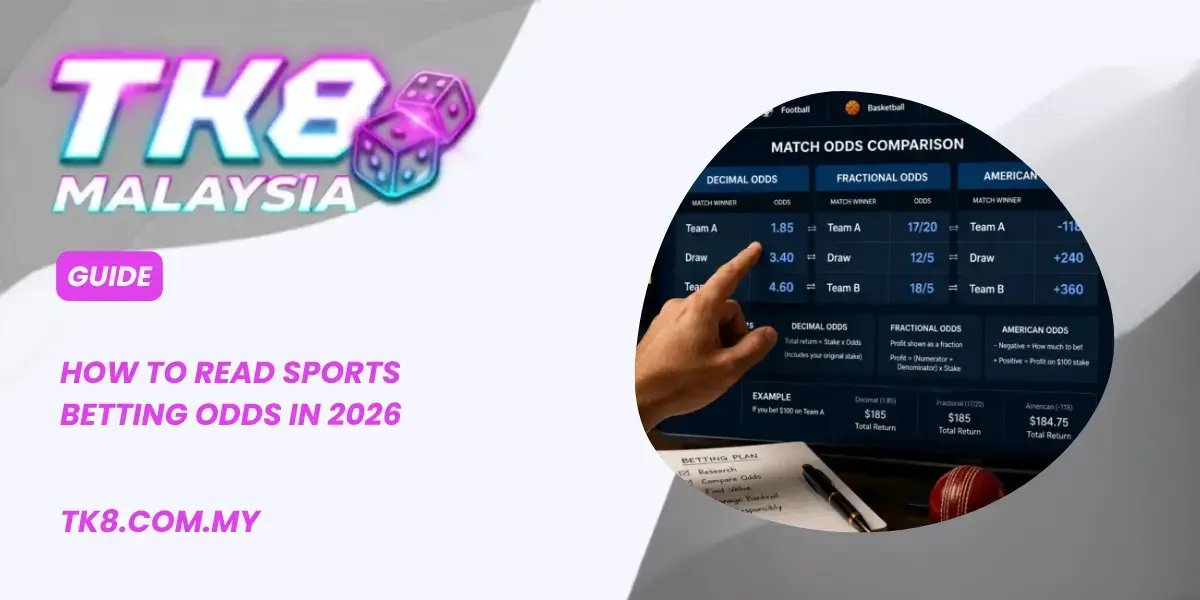
For example, one football team might have odds of 1.50 to win, while the other is listed at 5.00. This means the first team is seen as more likely to win.
However, sports betting odds show more than just possible payouts. They also reflect how likely the bookmaker thinks an outcome is, which you can turn into an implied probability.
Understanding this helps you read betting markets more clearly, so you don’t mistake low odds for a sure thing or high odds for a better chance.
If you follow sports in Malaysia, it’s helpful to know decimal odds. They make it easy to see your possible returns in Malaysian ringgit (MYR).
This guide explains how betting odds work, the main types of odds, how bookmaker margins affect prices, and why odds might change before or during a game.

What Are Sports Betting Odds?
Sports betting odds are numerical prices assigned to possible outcomes of a sporting event.
They show how much you could win if your bet is successful and give an idea of how likely the bookmaker thinks that outcome is.
For example, a football match may offer three possible results:
- Home team wins.
- Match ends in a draw.
- Away team wins.
How Do Decimal Betting Odds Work?
Online sportsbooks commonly display decimal odds. They represent the total potential return for each unit wagered, including the initial stake stake.
The calculation is:
Total Return = Stake × Decimal Odds
To calculate potential profit:
Potential Profit = Total Return − Stake
Example Using Malaysian Ringgit
Suppose a hypothetical wager has decimal odds of 2.50.
Stake | Decimal odds | Total return | Potential profit |
RM10 | 2.50 | RM25 | RM15 |
RM20 | 2.50 | RM50 | RM30 |
RM50 | 2.50 | RM125 | RM75 |
RM100 | 2.50 | RM250 | RM150 |
These examples assume the wager wins and is settled at the stated odds. If the wager loses, you generally lose the stake. Voids, refunds, and partial settlements follow the applicable market rules.
This calculation shows how odds affect your returns, but it doesn’t tell you how likely your bet is to win.
Understanding Implied Probability
Implied probability converts betting odds into a percentage.
For decimal odds, the formula is:
Implied Probability (%) = (1 ÷ Decimal Odds) × 100
For example, decimal odds of 2.00 imply a 50% probability.
Odds of 4.00 imply a probability of 25%.
Here is a comparison:
Decimal odds | Implied probability |
1.25 | 80% |
1.50 | 66.67% |
1.80 | 55.56% |
2.00 | 50% |
2.50 | 40% |
4.00 | 25% |
5.00 | 20% |
Why Lower Odds Don’t Mean a Guaranteed Win
Lower odds generally indicate that a bookmaker considers an outcome more likely than one with higher odds.
However, probability is not certain.
For example, decimal odds of 1.25 imply an 80% probability before adjusting for bookmaker margin.
That still leaves uncertainty.
In sporting events, unexpected results can occur because of injuries, tactical decisions, weather conditions, penalties, or individual performances.
A favorite can lose even when the available information strongly supports its chances.
That is why you should treat expressions like “sure win” or “guaranteed bet” with wariness.
Different Types of Betting Odds
Sportsbooks worldwide display odds in several formats.
Even though these formats look different, they can show the same value.
Decimal Odds
Decimal odds show the total return per unit wagered.
Example: 2.50
A winning RM10 wager would return RM25, including the initial stake.
Fractional Odds
Fractional betting odds are often associated with British betting markets.
Example: 3/2
This means you could win three units for every two units you bet.
A RM20 winning wager at 3/2 would generate RM30 in profit, plus the original RM20 stake.
American Odds
American odds use positive and negative numbers.
Positive odds indicate the profit associated with a hypothetical 100-unit stake.
Negative odds indicate how much you must wager to generate a hypothetical 100-unit profit.
For example:
- +150: A 100-unit stake would generate 150 units in profit if successful.
- −200: A 200-unit stake would generate 100 units in profit if successful.
These are just examples to show how the math works, not advice to place these bets.
What Is a Bookmaker Margin?
A bookmaker margin is the difference between the combined implied probabilities of all outcomes and 100%. It is sometimes called the overround.
Consider a hypothetical two-outcome market:
Outcome | Decimal odds | Implied probability |
Team A | 1.90 | 52.63% |
Team B | 1.90 | 52.63% |
Total | 105.26% |
The combined implied probability is approximately 105.26%.
The additional 5.26 percentage points represent the market’s overround.
This does not mean the bookmaker earns exactly 5.26% profit on every market. Actual financial results depend on how wagers are distributed and settled.
Understanding the margin helps you see why odds don’t always reflect real chances.
Why Do Sports Betting Odds Change?
Common reasons include:
- Injuries: An important player becomes unavailable.
- Team Lineups: Starting players differ from expectations.
- Suspensions: A player is ruled out because of disciplinary restrictions.
- Recent Performance: New results affect assessments of team strength.
- Weather Conditions: Rain, wind, or extreme temperatures may affect certain sports.
- Market Activity: Changes in wagering demand may influence prices.
- Tournament Conditions: Scheduling changes or fixture congestion may affect performance expectations.
Pre-Match Odds vs Live Betting Odds
Sports betting markets may be available before an event begins or while it is taking place.
Pre-Match Odds
Pre-match odds are published before the sporting event starts.
They may change as new information becomes available, including team news, injuries, and lineup announcements.
Live Betting Odds
Live odds update during an event. For example, football odds may change after a goal, red card, or significant change in the remaining playing time.
Basketball odds may move quickly as the score changes. Live betting can also involve delays, suspended markets, or price changes between selecting and confirming a wager.
These conditions make it important to understand the applicable acceptance and settlement rules.
How Odds Work Across Different Sports
The basic mathematics of decimal odds remains the same across sports.
But the types of bets you can make and what affects the odds can change depending on the sport.
Football
Football markets commonly include match winner, total goals, both teams to score, and handicap outcomes.
A three-way match-winner market typically includes a home win, a draw, and an away win.
Basketball
Basketball markets often include match winners, point spreads, totals, and quarter-specific outcomes.
Prices may change rapidly during live play because scoring is frequent.
Badminton
Badminton markets may include match winners, game winners, handicaps, and total points.
The scoring format and number of games can affect how markets are settled.
Tennis
Tennis markets may cover match winners, set winners, total games, and game handicaps.
Settlement rules can become especially important if a player retires before a match is completed.
Cricket
Cricket markets vary by match format. A Test match has different playing conditions and settlement considerations from a T20 match.
Know the rules and format of the sport when looking at betting options.
Common Mistakes When Reading Betting Odds
If you misunderstand odds, you might misjudge risk and potential returns.
Here are several common mistakes.
Confusing total return with profit
Decimal odds contain the original stake in the calculated total return.
Assuming low odds are safe
An outcome priced as a favorite can still lose.
Ignoring bookmaker margins
Implied probabilities from odds already include the bookmaker’s margin.
Comparing different markets
A match-winner market and a handicap market may have different settlement conditions, even when they involve the same teams.
Overlooking rule differences
Extra time, penalties, player retirements, or postponed and abandoned matches can change how bets settle, depending on the sport and market.
Treating odds movements as predictions
A shorter price does not guarantee that an outcome is becoming certain.
How to Evaluate Sports Betting Odds Responsibly
Useful practices include:
- Read the full market description before considering a wager.
- Check whether the quoted odds contain the original stake in the return.
- Understand the difference between probability and certainty.
- Review the settlement rules for the relevant sport.
- Avoid claims about guaranteed winning selections.
- Never increase spending solely to recover previous losses.
- Keep records of gambling-related expenses.
- Set personal monetary boundaries.
- Pause breaks when gambling begins to affect everyday responsibilities.
Frequently Asked Questions
Can two sportsbooks offer different odds for the same match?
Yes. Bookmakers may use different pricing models, margins, and market adjustments. The settlement rules may also differ, so identical-looking selections are not always directly comparable.
Do odds change after a bet has been accepted?
For an ordinary fixed-odds wager, the accepted price generally remains the basis for settlement. However, special market rules or alternative betting products may operate differently.
What happens if odds change before I confirm a wager?
The sportsbook may display a revised price or ask you to confirm the change. The applicable platform rules determine whether the sportsbook accepts the selection.
Are decimal odds always greater than 1.00?
Standard decimal odds for positive-return fixed-odds wagers are generally greater than 1.00. The minimum permitted price depends on the sportsbook and market.
Can implied probability exceed 100%?
A single standard decimal price greater than 1.00 implies a probability below 100%. However, the sum of implied probabilities over all outcomes can exceed 100% because of bookmaker margin.
Are odds the same as a team’s actual chance of winning?
No. Odds signify a bookmaker’s quoted price and incorporate pricing considerations. They are not direct measurements of the true probability of an outcome.
Why do some betting markets disappear during a live match?
Markets may be temporarily suspended because of major events, uncertainty, technical issues, or the need to update prices. Availability depends on the sportsbook’s rules.
Do higher odds always mean better value?
No. Higher odds offer a larger potential return relative to the stake, but they generally correspond to a lower implied probability. Determining value requires an independent probability assessment, which is still uncertain.
Are you ready to play slot games? You can try other casino games at TK8 Malaysia now!